Federal vs. State Benefits 2026: Better Support for US Families?
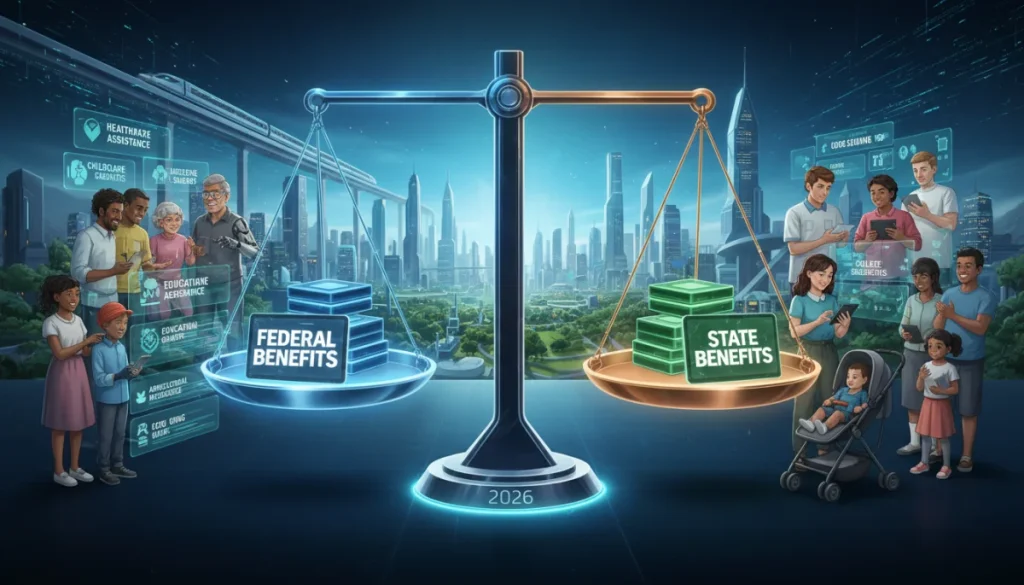
Comparing 2026 federal vs. state-specific benefits reveals crucial differences in financial support, impacting 80% of U.S. families based on need and geographic location.
Understanding the landscape of available aid is paramount for American families navigating financial complexities. This article delves into comparing 2026 federal vs. state-specific benefits, analyzing which system offers more robust support for the vast majority of U.S. households.
The evolving landscape of federal benefits in 2026
Federal benefits in 2026 continue to form the bedrock of social safety nets across the United States. These programs, standardized nationwide, aim to provide a baseline level of support regardless of where one resides. Their broad reach ensures a fundamental level of assistance, though the specifics can evolve with legislative changes.
Many federal programs are designed to address widespread societal challenges such as poverty, healthcare access, and unemployment. They typically operate under uniform eligibility criteria, making them predictable for many families. However, this uniformity can sometimes overlook the unique economic pressures faced by specific communities or regions.
Key federal aid programs and their reach
Several significant federal programs are projected to remain central to family support in 2026. These include initiatives that impact millions of Americans annually.
- Social Security: Provides retirement, disability, and survivor benefits, crucial for millions of older adults and individuals with disabilities.
- Medicare: Offers health insurance for people aged 65 or older, younger people with disabilities, and people with End-Stage Renal Disease.
- Medicaid: A joint federal and state program providing health coverage to low-income individuals and families. While federally mandated, states administer it with varying parameters.
- Supplemental Nutrition Assistance Program (SNAP): Helps low-income individuals and families purchase nutritious food.
- Federal Student Aid: Provides grants, loans, and work-study funds for higher education.
The federal government’s role in providing these benefits is to establish overarching guidelines and often to provide a significant portion of the funding. This ensures a baseline standard, but also means that changes at the federal level can have widespread implications for all beneficiaries.
In conclusion, federal benefits offer a critical, standardized layer of support for U.S. families. While their national scope provides consistency, the nuances of local needs often necessitate additional, more tailored assistance from state-specific programs.
Understanding state-specific benefit programs in 2026
State-specific benefit programs in 2026 complement federal aid by addressing localized needs and demographic specificities that national programs might not fully capture. These benefits often reflect the unique economic conditions, cost of living, and policy priorities of individual states.
Unlike federal programs, state-level initiatives can vary dramatically from one state to another. This means that a family’s access to certain types of assistance, or the generosity of that assistance, can largely depend on their geographic location within the U.S. These variations are often a direct result of state legislative decisions and available state budgets.
Variations in state-level support
States have considerable autonomy in designing and funding their own benefit programs. This can lead to significant disparities in areas such as housing assistance, childcare subsidies, and unemployment benefits.
- Housing Assistance: Some states offer robust rental assistance or homeownership programs beyond federal Section 8.
- Childcare Subsidies: State-funded programs can significantly reduce childcare costs, which are a major burden for many working families.
- Unemployment Insurance: While federally guided, states set their own benefit amounts and duration, leading to substantial differences.
- Energy Assistance: Many states provide additional aid to help residents with heating and cooling costs, especially in extreme climates.
The flexibility of state programs allows for more targeted interventions, responding to specific local crises or long-standing community needs. For instance, a state with a high cost of living might offer more substantial housing aid, while a state with an aging population might focus more on senior services.
Ultimately, state-specific benefits play a crucial role in filling gaps left by federal programs and tailoring support to local contexts. Families must be aware of their state’s offerings to maximize potential aid.
Eligibility criteria: federal versus state
Navigating the eligibility criteria for benefit programs can be a complex endeavor, as requirements often differ significantly between federal and state-specific initiatives. Understanding these distinctions is crucial for families seeking support in 2026. Federal programs typically establish broad, national standards, while state programs introduce additional, often more granular, conditions.
For federal benefits, criteria often revolve around income thresholds, household size, age, disability status, or specific life events. These are generally consistent across all states, ensuring a baseline of access. However, even within federal programs, states can sometimes influence certain aspects of implementation, particularly with joint programs like Medicaid.
Key differences in eligibility requirements
The disparities in eligibility can be a major factor in determining which programs a family can access. State programs frequently add layers of criteria that reflect local economic conditions or policy priorities.
- Income Thresholds: Federal programs set national poverty lines, but states can adjust these for their own programs, often higher in high-cost-of-living areas.
- Residency Requirements: State-specific benefits almost always require proof of residency within that particular state for a minimum duration.
- Asset Limits: Some state programs impose stricter asset limits than federal counterparts, scrutinizing savings, property, and other holdings more closely.
- Work Requirements: While federal programs may have work requirements (e.g., for SNAP), states often implement their own additional or stricter work-related conditions for state aid.
These varying criteria mean that a family eligible for a federal program might not qualify for a similar state program, or vice versa. It underscores the importance of researching both federal and state guidelines thoroughly.
In summary, while federal benefits provide a uniform foundation, state-specific eligibility criteria introduce a layer of complexity. Families need to meticulously examine both sets of requirements to determine their full scope of potential assistance.
Financial impact on 80% of U.S. families
The combined financial impact of federal and state-specific benefits on 80% of U.S. families in 2026 is substantial, acting as a critical buffer against economic hardship and a facilitator of upward mobility. These programs collectively inject billions of dollars into households, supporting essential needs from food and housing to healthcare and education.
For many low-to-middle income families, these benefits can mean the difference between financial stability and crisis. They mitigate the effects of inflation, job loss, and unexpected expenses, ensuring that basic necessities are met. The interplay between federal and state aid often creates a more comprehensive support system than either could provide alone.
How combined benefits bridge economic gaps
Families often utilize a combination of federal and state benefits to address various aspects of their financial lives. This integrated approach can significantly improve their overall economic well-being.
- Healthcare Access: Medicaid (federal-state) combined with state-specific health initiatives ensures broader health coverage.
- Food Security: SNAP (federal) often supplemented by state food banks or nutrition programs, addresses hunger effectively.
- Housing Stability: Federal housing vouchers (Section 8) can be complemented by state or local rental assistance, preventing homelessness.
- Educational Opportunities: Federal student aid alongside state scholarship programs makes higher education more accessible.
The effectiveness of this combined approach is highly dependent on a family’s awareness and ability to navigate the application processes for both federal and state programs. Misinformation or lack of access to resources can hinder families from fully leveraging available support.
In conclusion, the synergistic effect of federal and state benefits provides a crucial financial safety net for the majority of U.S. families. Understanding how to access and combine these resources is key to maximizing their positive economic impact.
Case studies: real-world scenarios in 2026
Examining real-world scenarios helps illustrate how the interplay between federal and state-specific benefits affects families in 2026. These case studies highlight the diverse needs and outcomes depending on a family’s circumstances and location, offering a practical perspective on the theoretical comparisons.
Consider a single mother in California struggling with high childcare costs versus a retired couple in Florida managing healthcare expenses. Their access to and reliance on federal versus state aid will differ significantly, showcasing the mosaic of support systems across the nation.
Diverse family impacts across states
Let’s look at a few hypothetical examples:
- The Garcia Family (Texas): A family of four with a fluctuating income, eligible for federal SNAP benefits. Texas also offers state-funded utility assistance, crucial during extreme weather. The combination helps them manage food and energy bills, but limited state housing aid means they still struggle with rent.
- The Chen Family (New York): A working-class couple with two children, benefiting from federal Medicaid. New York’s robust state-funded childcare subsidies significantly reduce their monthly expenses, allowing them to save for their children’s education. Their state’s higher minimum wage also provides a better baseline income.
- The Johnson Family (Arizona): An elderly couple on fixed income, relying on federal Social Security and Medicare. Arizona’s state-specific prescription drug assistance program is vital for managing their chronic health conditions, as federal Medicare Part D doesn’t cover all their medication costs.
These examples underscore that while federal benefits provide a floor, state programs often determine the ceiling of available support, particularly for families facing specific regional challenges like high cost of living or unique health needs.
These case studies demonstrate that optimal support for families often comes from a strategic combination of both federal and state benefits, tailored to their specific circumstances and geographic location.
Strategies for maximizing benefit access in 2026
For U.S. families in 2026, strategically maximizing access to both federal and state-specific benefits is essential for achieving financial stability and well-being. This requires proactive research, diligent application, and an understanding of how different programs can complement each other.
Families should not assume that eligibility for one program automatically precludes them from others. Instead, a comprehensive approach to exploring all available avenues of support, federal and state, is often the most effective strategy. This involves understanding the nuances of each program’s requirements and application processes.
Tips for navigating the benefits landscape
Successfully accessing benefits often involves more than just meeting eligibility criteria; it also requires effective navigation of the application and approval processes.
- Thorough Research: Utilize official government websites (federal and state) to understand program details, eligibility, and application procedures.
- Documentation Readiness: Gather all necessary documents (proof of income, residency, identification, etc.) before starting applications to avoid delays.
- Seek Assistance: Non-profit organizations, community centers, and state agencies often provide free assistance with benefit applications.
- Understand Appeals Processes: If an application is denied, understand the reasons and the process for appealing the decision.
- Regular Review: Benefit programs and eligibility criteria can change. Regularly review your eligibility and available programs to ensure you’re maximizing support.
Furthermore, families should consider how different benefits interact. For instance, receiving a federal housing voucher might affect eligibility for certain state-level housing grants. A holistic view is crucial.
In conclusion, maximizing benefit access in 2026 involves a proactive and informed approach. By understanding the federal and state landscapes and employing strategic application methods, families can significantly enhance their financial support.
| Key Aspect | Description |
|---|---|
| Federal Benefits | Nationally standardized, provide baseline support (e.g., Social Security, Medicare, SNAP). |
| State Benefits | Varied by state, address local needs, complement federal aid (e.g., housing, childcare). |
| Eligibility | Federal has national criteria; state adds specific residency, income, and asset rules. |
| Financial Impact | Combined federal and state aid crucial for stability for 80% of US families, bridging gaps. |
Frequently asked questions about 2026 benefits
Federal benefits are nationally standardized, providing a uniform baseline of support across the U.S. State benefits, conversely, are tailored to specific local needs and economic conditions, varying significantly from one state to another in scope and generosity.
Neither federal nor state benefits definitively offer ‘better’ support in isolation. Optimal support typically arises from a strategic combination of both, leveraging federal programs for foundational needs and state programs to address specific local challenges and enhance overall assistance.
Federal programs primarily use national criteria like income and household size. State programs often add layers of requirements, including specific residency durations, stricter asset limits, and unique work requirements that reflect local policy priorities and economic conditions.
Yes, receiving federal benefits can sometimes impact eligibility for state-specific aid. Some state programs consider federal assistance as income or assets, potentially altering your qualification status. It’s crucial to review the specific guidelines for each state program.
Families should consult official government websites (e.g., USA.gov for federal, and individual state government sites) for the most accurate and up-to-date information. Additionally, local community organizations and non-profits often provide assistance and guidance on navigating benefit programs.
Conclusion
In conclusion, the comparison between federal and state-specific benefits in 2026 reveals a complex yet complementary system designed to support U.S. families. While federal programs provide a crucial, standardized foundation, state initiatives offer the flexibility and tailored assistance necessary to address diverse local needs. For the 80% of U.S. families seeking better support, the most effective strategy lies in understanding and strategically combining both federal and state resources. Proactive research, meticulous application, and an awareness of evolving eligibility criteria are paramount to maximizing financial well-being in the dynamic benefits landscape of 2026.